Cristiano Ronaldo Net Worth, Biography, and Career Earnings
Cristiano Ronaldo’s net worth, biography, and career earnings tell the story of a footballer who turned extraordinary performance into a global commercial empire. His income has come from record-breaking contracts, major transfer fees, endorsement deals, social-media influence, and the CR7 brand built around his name.
There isn’t one audited public figure for his personal wealth, so estimates vary. The useful answer is the range: by the mid-2020s, published estimates commonly place Cristiano Ronaldo’s net worth somewhere around $800 million to more than $1 billion, while his annual income has reached several hundred million dollars in some years.
How much is Cristiano Ronaldo worth?
The most responsible estimate for Cristiano Ronaldo’s net worth is roughly $800 million to $1 billion or more, depending on how analysts value private investments, property, sponsorship rights, and future contract income. No public filing provides a definitive personal balance sheet, so any precise figure should be treated as an estimate rather than a confirmed fact.
His yearly earnings are easier to track than his total wealth. Forbes reported that Ronaldo earned an estimated $275 million in 2025, combining on-field compensation with off-field income, placing him at the top of its athlete earnings rankings for that year.
That annual figure does not mean he adds $275 million directly to his net worth. Taxes, agent fees, staff costs, business expenses, charitable giving, property purchases, and investments all reduce the amount retained.
| Category | What is publicly reported or estimated | Why the figure varies |
|---|---|---|
| Estimated net worth | $800 million to more than $1 billion | Private assets and business valuations are not fully disclosed |
| Estimated 2025 earnings | About $275 million, according to Forbes | Includes salary, bonuses, sponsorships, and commercial income |
| Saudi club compensation | Reported at roughly $200 million per year before additional commercial arrangements | Contract terms have not been published in full |
| Career gross income | Likely well above $1 billion | Totals differ depending on whether endorsements, taxes, and bonuses are counted |
The distinction between earnings and net worth matters. Career earnings describe money generated over time, while net worth measures what remains after spending, taxes, liabilities, and asset values are considered.
From Madeira to Sporting CP
Cristiano Ronaldo dos Santos Aveiro was born on 5 February 1985 in Funchal, Madeira, Portugal. He grew up in the São Pedro area and came from a working-class family; his father, José Dinis Aveiro, worked as a kit man and equipment manager, while his mother, Maria Dolores dos Santos Aveiro, helped support the household.
Ronaldo joined Nacional in Madeira as a child before moving to Sporting CP’s academy on the Portuguese mainland at about age 12. The relocation separated him from his family at a young age, but it placed him inside one of Portugal’s most respected football development systems.
At Sporting CP, coaches noticed his pace, balance, close control, and willingness to practise. He made his first-team debut in 2002, aged 17, and scored twice in a league match against Moreirense during that early senior campaign.
His Sporting career was brief, yet one friendly match changed the direction of his life. Sporting played Manchester United in 2003, and Ronaldo’s performance impressed United players and manager Sir Alex Ferguson enough to lead to a transfer.
The move to England came with a reported fee of about £12.2 million, a significant amount for a teenager at the time. Ronaldo became Manchester United’s first Portuguese player and inherited the famous number seven shirt after David Beckham’s departure.
That shirt created pressure immediately. Ronaldo responded by adding strength, improving his decision-making, and becoming more productive in front of goal.
Manchester United and the first major fortune
Ronaldo joined Manchester United in 2003 and spent six seasons at Old Trafford. He began as an exciting but sometimes lightweight winger, then developed into a powerful forward capable of scoring from open play, set pieces, counterattacks, and headers.
His breakthrough came during the 2006–07 season, when he scored 23 goals in all competitions and helped United win the Premier League. The next campaign was even bigger: he scored 42 goals in 49 matches across competitions as United won the Premier League and UEFA Champions League.
Ronaldo won the 2008 Ballon d’Or, FIFA World Player of the Year, and the European Golden Shoe after that remarkable season. Individual awards improved his commercial value, while success at Manchester United allowed him to negotiate stronger wages and sponsorship arrangements.
His Manchester United career produced three Premier League titles, one Champions League crown, one FA Cup, two League Cups, and a FIFA Club World Cup. He scored 118 goals in 292 appearances for the club according to Manchester United’s published historical records.
United sold him to Real Madrid in 2009 for a reported £80 million, then a world-record transfer fee. Transfer fees go to clubs rather than directly into a player’s bank account, but they influence salary negotiations, bonuses, image rights, and the market’s assessment of a player’s value.
Manchester United also established Ronaldo as a global commercial figure. His shirt sales, Nike relationship, and growing international profile created a foundation for the endorsement income that later became as important as his football salary.
Real Madrid made him a global superstar
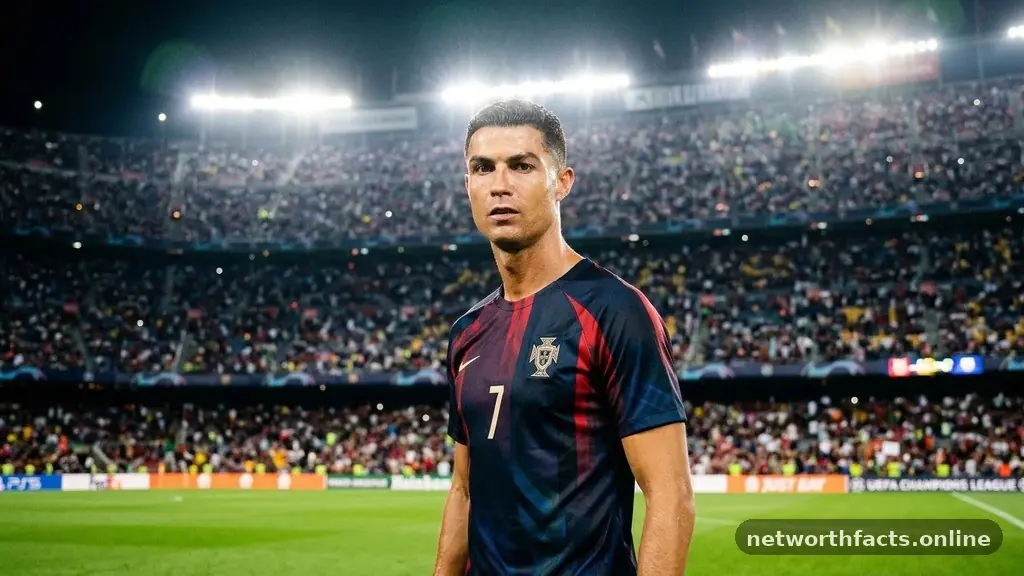
Real Madrid presented Ronaldo in 2009 before an enormous crowd at the Santiago Bernabéu. He wore number nine at first, then reclaimed number seven after Raúl González left, turning the “CR7” identity into one of sport’s most recognisable personal brands.
His nine seasons in Madrid transformed both his sporting record and his finances. Ronaldo scored 450 goals in 438 official appearances for Real Madrid, making him the club’s all-time leading scorer.
During that period, he won four Champions League titles, two La Liga titles, three Club World Cups, two Copa del Rey trophies, and several other major honours. He also won the Ballon d’Or four times as a Real Madrid player, adding to the award he had earned at Manchester United.
His Real Madrid contract was repeatedly improved as his performances set new standards. Salary, performance bonuses, image-rights arrangements, and loyalty payments all contributed to his career earnings, although the exact after-tax amounts are not publicly available.
The club’s global reach also amplified his off-field value. A Real Madrid match could reach viewers across Europe, Asia, the Middle East, Africa, and the Americas, giving sponsors access to a worldwide audience attached to one individual athlete.
Ronaldo left Madrid for Juventus in 2018 in a transfer reported at about €100 million plus additional costs. He had won the Champions League five times by then, and his move demonstrated that a player in his thirties could still command a huge commercial and sporting price.
Real Madrid was the central chapter in his biography because it joined unprecedented goalscoring with a contract scale few footballers had previously reached. The club years also pushed his social-media following and endorsement power to another level.
Juventus, Manchester United, and Al-Nassr
Ronaldo signed for Juventus in 2018, with reports placing his annual salary near €30 million. He scored 101 goals in 134 official matches for the Italian club and won two Serie A titles, a Coppa Italia, and a Supercoppa Italiana.
Juventus paid heavily for both performance and visibility. The club gained a player who had already won the Champions League multiple times, while Ronaldo brought international attention and strong merchandise demand to Italian football.
He returned to Manchester United in 2021. Ronaldo scored 24 goals in all competitions during the 2021–22 season, but his second spell ended after a public dispute with the club and a mutually agreed contract termination in November 2022.
Al-Nassr announced Ronaldo’s signing at the end of 2022. Reports placed his base compensation at approximately $200 million per year, with other commercial and promotional arrangements potentially taking the overall package higher.
The exact Al-Nassr agreement has not been released in full. Claims about ambassadorial duties connected to Saudi Arabia’s 2034 World Cup bid have circulated widely, but readers should separate confirmed club announcements from unattributed reports.
His move to Saudi Arabia changed the economics of his late career. Instead of competing for a European Champions League club, he became the leading global face of the Saudi Pro League and helped attract attention to a competition investing heavily in international stars.
Across Sporting CP, Manchester United, Real Madrid, Juventus, Manchester United again, and Al-Nassr, Ronaldo’s club income has come from more than a single wage figure. Bonuses, image rights, signing payments, commercial appearances, and contract incentives have all shaped his career earnings.
Endorsements and the CR7 brand
Ronaldo’s endorsement deals are a major reason his financial profile extends far beyond his football salary. He has worked with brands including Nike, Herbalife, Clear, TAG Heuer, and numerous regional partners, though individual contracts differ in length, scope, and payment structure.
The most important relationship is his long-running partnership with Nike. Reports have described it as a Nike lifetime contract, but the full financial terms have never been publicly disclosed.
His CR7 brand includes underwear, footwear, fragrances, hotels, gyms, and other licensed products. Some ventures are operated through partnerships, so the gross sales associated with a product line should not automatically be treated as Ronaldo’s personal profit.
- Football contracts: club salary, signing payments, appearance fees, and performance bonuses.
- Nike partnership: long-term footwear and apparel income connected to the CR7 identity.
- Other endorsement deals: campaigns with global and regional consumer brands.
- CR7 products: underwear, fragrances, footwear, hotels, and licensed merchandise.
- Digital influence: sponsored posts and promotional value generated by his enormous social following.
- Investments: property and business interests whose market values can change over time.
Social media has become an economic asset in its own right. Ronaldo has regularly ranked among the most-followed people on Instagram, allowing a single branded post or campaign to reach hundreds of millions of followers without relying solely on traditional advertising.
Forbes athlete earnings estimates usually divide income into on-field and off-field categories. Ronaldo’s off-field earnings have often exceeded those of many athletes who receive similar sporting attention, because his audience is unusually large and his brand operates across several industries.
The CR7 model also gives him control over presentation. Instead of appearing only as a sponsored athlete, he can attach his name to products, hotels, training facilities, and experiences that reinforce the same visual identity.
Properties, lifestyle, and publicly known assets
Ronaldo has bought and sold high-value homes in Portugal, Spain, England, and the United States. Media reports have associated him with luxury properties in Madeira, Lisbon, La Finca near Madrid, and the Portuguese Riviera, although valuations and ownership structures can change.
His Madeira property became particularly visible because it includes a modern residence and ocean views in Funchal. Ronaldo has also been photographed with luxury cars, watches, private aircraft, and yachts, but a photograph does not prove whether an item is personally owned, leased, borrowed, or held through a company.
Hotel investments form another part of the public story. Ronaldo partnered with the Pestana Hotel Group on the Pestana CR7 hotel brand, with properties announced in locations including Funchal, Lisbon, Madrid, New York, Marrakech, and other destinations over time.
The partnership structure matters. A celebrity may receive licensing income, equity, management fees, or a combination of those arrangements rather than owning every building associated with the brand.
Ronaldo’s spending is highly visible, but visible luxury is only one part of wealth. Business interests, cash reserves, investment portfolios, property equity, and contractual rights can be more financially important than a car or watch shown in a social-media post.
There is also a practical reason net-worth estimates differ. A house may be valued at its current market price, while a private company may be valued using projected earnings, comparable businesses, or an undisclosed agreement between partners.
Readers who want to verify background facts about his playing career can consult the Encyclopaedia Britannica biography of Cristiano Ronaldo. For wealth estimates, however, even respected publications rely on modelling and publicly reported information rather than access to a complete personal ledger.
Portugal, records, and the legacy behind the money
Ronaldo made his Portugal debut in 2003 and became the defining figure of the country’s modern national team. He helped Portugal win the 2016 UEFA European Championship, the nation’s first major senior men’s football title.
He also helped Portugal win the inaugural UEFA Nations League in 2019. That trophy added a second senior international honour and strengthened a national-team record that had already become extraordinary.
Ronaldo has been recognised as one of the highest-scoring players in international football history. FIFA and UEFA records have credited him with becoming the men’s leading international goalscorer, passing 110 goals for Portugal in 2021.
His international career includes appearances at multiple European Championships and World Cups. He became the first male player to score at five different FIFA World Cup tournaments, a record reached at the 2022 tournament in Qatar.
International success does not pay like a club contract. Portugal’s national team salary and match bonuses are important professionally, but they are not the main source of his fortune.
The national team matters commercially because it gave Ronaldo a year-round identity beyond club loyalties. Fans could follow him with Portugal, Manchester United, Real Madrid, Juventus, or Al-Nassr, while sponsors benefited from that continuity.
His career also changed how footballers think about longevity. Ronaldo remained productive into his late thirties through intense training, nutrition, recovery routines, and careful attention to his public image.
That longevity protected his earning power. A younger player may have more future seasons but less proven commercial reach; Ronaldo has combined a long career with records that keep him relevant to sponsors and broadcasters.
Why estimates should be read carefully
Search results often present a single Cristiano Ronaldo net worth figure as if it were an official fact. It isn’t. The number may be based on reported salaries, estimated endorsement income, property valuations, and assumptions about taxes or spending.
Career earnings create a similar problem. A publication might count gross wages before tax, while another subtracts taxes and agent commissions; one may include bonuses and sponsorships, while another leaves out business revenue.
A sensible reading method is to ask three questions:
- Is the number attributed? A figure from Forbes, a club announcement, or a named financial publication is more useful than an anonymous social-media claim.
- Does it describe gross income or retained wealth? Salary is not the same as net worth, and endorsement revenue is not the same as profit.
- Is the date clear? A 2018 estimate cannot accurately describe Ronaldo’s finances after his Al-Nassr contract and later business growth.
Currency conversion adds another layer of uncertainty. Ronaldo has earned pounds, euros, dollars, and Saudi riyals, and exchange rates can change the apparent size of a contract without changing its local purchasing power.
Contract language matters too. A reported “package” may combine base salary, bonuses, commercial rights, image rights, and promotional obligations. Only part of that amount may be guaranteed.
The clearest conclusion is therefore a range, not false precision. Ronaldo has generated well over a billion dollars in gross career income by many reasonable calculations, while his personal net worth is probably in the high hundreds of millions or above.
Frequently asked questions
What is Cristiano Ronaldo’s estimated net worth?
Published estimates commonly place Cristiano Ronaldo’s net worth between $800 million and more than $1 billion. The range reflects uncertainty around private investments, property values, business ownership, taxes, and the undisclosed terms of some commercial agreements.
How much does Ronaldo earn from Al-Nassr?
Reports have placed his Al-Nassr compensation at approximately $200 million per year, before considering possible commercial arrangements. The complete contract has not been published, so the exact guaranteed amount and bonus structure remain uncertain.
What is Ronaldo’s biggest source of income?
His biggest source can change by year. During the Al-Nassr period, club compensation has likely been dominant, while endorsement deals, the Nike relationship, sponsored content, and CR7 businesses provide substantial off-field income.
How many Ballon d’Or awards has Ronaldo won?
Ronaldo has won the Ballon d’Or five times: in 2008, 2013, 2014, 2016, and 2017. His first award came while he played for Manchester United, and the other four arrived during his Real Madrid career.
Did transfer fees go directly to Ronaldo?
No. Transfer fees are paid by the buying club to the selling club. They can indirectly raise a player’s wages, bonuses, and commercial value, but the headline transfer amount is not normally a direct payment to the footballer.
The lasting picture
Cristiano Ronaldo’s net worth, biography, and career earnings are inseparable from the timeline of his career: Sporting CP development, Manchester United success, Real Madrid records, Juventus ambition, a second United spell, and the Al-Nassr era. His fortune reflects both elite football income and a commercial identity that has grown far beyond match days.
The exact total will remain private, but the broad conclusion is clear: he has built one of sport’s largest personal businesses. When new estimates appear, check the date, source, and difference between gross earnings and net worth before accepting the headline figure.