Taylor Swift Net Worth, Career, Age, and Sources of Income
Taylor Swift’s net worth, career, age, and sources of income reveal how a teenage country singer became one of the most powerful figures in modern music. Estimates place her fortune in the billionaire range, while her songwriting, music catalog, concert tours, and business decisions explain how that wealth was built.
She was born on December 13, 1989, making her 35 years old in 2025 and due to turn 36 on December 13. The headline numbers are impressive, but the more useful story is how album sales, streaming royalties, touring revenue, merchandise, endorsements, and property have worked together over nearly two decades.
How Much Is Taylor Swift Worth?
Public estimates generally place Taylor Swift’s net worth at approximately $1.6 billion, although the figure is not an audited personal balance sheet. Forbes reported that she became a billionaire in 2023 and later estimated her fortune at around $1.6 billion, while Bloomberg previously published a lower estimate of roughly $1.1 billion.
Those differences are normal for celebrity wealth estimates. A person’s assets may include private company interests, real estate, cash, investments, and the estimated value of intellectual property, while debts, taxes, management fees, and changing market values may be treated differently by each publication.
Swift’s fortune is unusual because a large share is tied to identifiable creative assets rather than only endorsement contracts. Her music catalog, music publishing rights, real estate portfolio, and touring income provide several separate foundations for her wealth.
| Wealth component | What it includes | Why it matters |
|---|---|---|
| Music catalog | Recorded albums and related rights | Can produce licensing, sales, and streaming income |
| Songwriting | Publishing rights and performance royalties | Swift wrote or co-wrote a large share of her songs |
| Concert touring | Ticket sales, promotions, and related products | The Eras Tour became a major source of earnings |
| Real estate | Homes and other property holdings | Represents a substantial asset base, though values fluctuate |
Net worth should not be confused with annual income. A tour may generate enormous gross ticket revenue, but the artist does not keep all of it after venue costs, production, staff, taxes, promoters, commissions, and transportation.
Even with that caution, Swift’s position is clear. Her wealth has been created through ownership and participation across the entire music business, not simply through a high salary from a record label.
Age, Background, and the Start of Her Career
Taylor Alison Swift was born in West Reading, Pennsylvania, and spent part of her childhood on a Christmas tree farm before moving to Nashville as a teenager. The move placed her near the centre of the country music industry while she was still developing as a performer and songwriter.
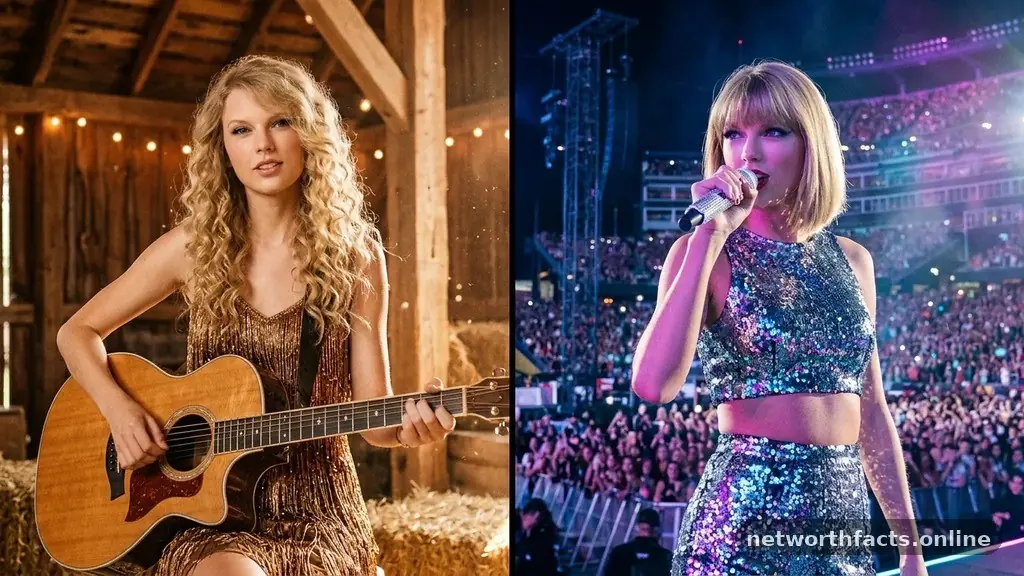
At age 14, Swift signed a music publishing deal with Sony/ATV, becoming one of the youngest artists to receive that kind of agreement. She later signed with Big Machine Records, and her self-titled debut album arrived in 2006 when she was 16.
That first album established the pattern that would define her career: writing personal songs, connecting with a young audience, and turning individual tracks into long-term catalog assets. Songs such as “Tim McGraw” and “Teardrops on My Guitar” helped her move from emerging country artist to national pop-culture presence.
Swift’s early career also demonstrated the value of songwriting ownership. Instead of depending entirely on material supplied by professional writers, she built her public identity around songs that reflected her own experiences, observations, and voice.
From country success to global pop
Her second album, Fearless, expanded her audience dramatically and won the Grammy Award for Album of the Year. The album’s singles, including “Love Story” and “You Belong with Me,” gave Swift crossover reach without requiring her to abandon the country influences that shaped her beginnings.
Speak Now strengthened her reputation as a solo songwriter, while Red introduced a more ambitious mixture of country, pop, rock, and electronic sounds. With 1989, Swift made an intentional full transition into pop, producing major singles such as “Blank Space,” “Style,” and “Shake It Off.”
Her career continued to change through Reputation, Lover, Folklore, Evermore, Midnights, and The Tortured Poets Department. Each release expanded the value of her catalog while giving her new opportunities in touring, streaming, merchandising, and licensing.
Music and Songwriting Income
Songwriting royalties are one of the most important parts of Swift’s financial picture. When a song is played on the radio, streamed, performed publicly, licensed for a film, or reproduced on a physical or digital product, different royalties may flow to the songwriter, publisher, recording owner, performer, or other rights holders.
Swift’s position is especially strong because she has written or co-written most of her major songs. She therefore participates in publishing income as well as income connected to the sound recordings themselves.
- Songwriting royalties: payments connected to the composition, lyrics, and melody.
- Music publishing rights: control or participation in the underlying written songs.
- Streaming royalties: income generated when recordings are played on digital services.
- Mechanical royalties: payments tied to reproducing songs in physical or digital formats.
- Performance royalties: money collected when compositions are performed publicly.
- Licensing revenue: payments for using songs in films, television, advertising, or other media.
The exact amount Swift earns per stream is not a simple fixed rate. Streaming services generally distribute money through agreements involving labels, publishers, collection organisations, and rights holders, so the result varies by territory, platform, contract, and the type of right involved.
Album sales remain relevant even in a streaming-driven industry. Swift has sold millions of physical albums, including vinyl editions and special versions that encourage fans to collect different artwork, colours, bonus tracks, or packaging.
Her re-recording project added another important dimension. After a dispute over the ownership of her early master recordings, Swift began releasing “Taylor’s Version” editions of several albums, allowing her to create new recordings and redirect listener attention toward versions in which she has greater control.
The Eras Tour and Concert Revenue
The Eras Tour became the most visible engine of Swift’s recent earnings. It began in 2023 as a career-spanning production covering different periods of her music career and continued through 2024, reaching stadium audiences across multiple continents.
Pollstar reported that the tour became the first concert tour to surpass $1 billion in reported ticket sales. Gross ticket revenue is not the same as Swift’s personal profit, but the scale shows why concert tours can transform an artist’s financial position in a short period.
Tour revenue is divided among many participants. Stadiums receive fees, promoters manage sales and local operations, production requires stages and equipment, and hundreds of workers support dancers, musicians, costumes, transport, security, catering, and technical work.
Swift still benefits from the unusually large size of the production. A massive stadium tour can sell millions of tickets, create strong merchandise demand, generate local economic activity, and increase streams and album sales for the artist’s entire catalog.
More than ticket sales
Merchandise sales add another layer to the touring business. Clothing, posters, accessories, special editions, and tour-specific products allow fans to spend beyond the ticket price, while the tour itself creates a natural setting for those purchases.
The concert film Taylor Swift: The Eras Tour also extended the project beyond live venues. Released in cinemas in 2023, it earned hundreds of millions of dollars at the global box office and showed how a concert performance can become a separate entertainment product.
Streaming activity often rises around a major tour as casual listeners revisit older albums and new fans discover earlier work. That effect helps explain why the financial impact of a successful tour can continue after the final scheduled performance.
Swift’s touring power also changes negotiations with venues, promoters, and business partners. An artist who can sell stadiums at extraordinary speed has more leverage over ticketing arrangements, production choices, merchandise, and the timing of future performances.
Album Ownership and the Re-Recording Strategy
Swift’s relationship with her music catalog has been central to her career and finances. Her first six studio albums were released through Big Machine, whose founder Scott Borchetta sold the label and the masters associated with those recordings to Ithaca Holdings in 2019.
Swift publicly objected to the transaction and said she had not been given the opportunity to buy her early masters on terms she could accept. The dispute made ownership of sound recordings a mainstream conversation, particularly for younger artists negotiating record contracts.
Her response was to re-record eligible albums. Fearless (Taylor’s Version) arrived in 2021, followed by Red (Taylor’s Version) later that year, Speak Now (Taylor’s Version) in 2023, and 1989 (Taylor’s Version) in 2023.
These releases were not merely symbolic. New recordings give Swift greater control over the versions being promoted, streamed, licensed, and sold, while the continued popularity of the originals makes the project commercially significant.
The re-recordings also introduced “From the Vault” songs that had not appeared on the original albums. Those tracks gave established albums a fresh news cycle and created new listening events for fans who already knew the older material.
Why ownership changes the economics
A master recording is the actual recorded performance, while publishing generally concerns the underlying composition. An artist may control one without controlling the other, and the income from each can move through different contractual channels.
Swift’s songwriting gives her an unusually strong position on both sides of that distinction. Her work as a writer supports publishing income, while her re-recordings provide new masters that she can use to compete with earlier versions.
The strategy also protects long-term value. A music catalog can produce income for decades through streaming, radio, physical sales, synchronisation licensing, and public performances, so decisions made early in a career may affect wealth long after a release leaves the charts.
Swift’s approach encouraged wider discussion about artist contracts, master ownership, streaming economics, and the financial meaning of creative control. It turned a private industry dispute into a visible example of why intellectual property matters.
Endorsements, Film, and Business Partnerships
Brand endorsements have contributed to Swift’s income, although they appear to be less central than touring and music ownership. Over the years, she has worked with companies including Diet Coke, Apple, Capital One, and others through advertising campaigns or commercial partnerships.
Her endorsement choices have often been linked to specific moments in her public image. A campaign can support an album era, promote a tour, reach a new audience, or connect a product with the cultural attention surrounding her music.
Swift has also earned from film-related work. She appeared in projects including Valentine’s Day, The Lorax, and Cats, and she directed the short film for “All Too Well (10 Minute Version).” Film income is difficult to separate from her total wealth because contracts and compensation terms are generally private.
The Eras Tour concert film was a particularly important example of an artist using direct influence over a major release. Rather than treating the performance only as a conventional studio-backed film, the project was distributed theatrically as a large-scale event for fans.
Swift also has a business interest in her own brand identity. Album artwork, visual eras, merchandise design, fan communication, music videos, and touring presentation all reinforce a recognisable commercial world around each release.
That does not mean every product connected with her name is owned entirely by Swift. Licensing agreements, manufacturing arrangements, distributors, labels, and other partners may share revenue, and the public usually cannot see the precise terms.
Real Estate and Other Major Assets
Real estate forms another visible part of Swift’s net worth. Publicly reported holdings have included properties in New York, Rhode Island, Nashville, Beverly Hills, and elsewhere, although ownership structures, current valuations, and sale details can change.
Her New York properties include residences in the Tribeca area, where she has assembled multiple units over time. The combined value of those homes has been reported in the tens of millions of dollars, but estimates depend on renovations, market conditions, square footage, and whether a property is assessed individually or as part of a larger collection.
Swift’s Rhode Island home, known as High Watch, became widely recognised after she hosted a 2013 Fourth of July gathering there. The coastal property has also appeared in discussions of celebrity real estate because of its size, location, and privacy.
In Nashville, where her professional career began, Swift has owned properties connected to her early success. These homes reflect an important part of her personal history as well as her broader real estate portfolio.
Property is not the same as cash. A luxury home may appreciate over time, but it also brings insurance, maintenance, property taxes, security, renovations, and transaction costs.
Other assets may include cash reserves, investments, artwork, vehicles, and private business interests, but reliable public details about those holdings are limited. Responsible estimates therefore focus on information that can be reasonably documented instead of assigning invented values to every possible possession.
Career Milestones and Recognition
Swift’s financial growth has followed a sequence of career milestones rather than one sudden payday. Her debut established a commercial audience, Fearless made her a major award winner, and 1989 proved she could move decisively into global pop without losing her songwriting identity.
She has won multiple Grammy Awards, including Album of the Year for Fearless, 1989, Folklore, and Midnights. Her fourth Album of the Year win for Midnights made her the first performer to receive that particular award four times.
Commercially, her albums have repeatedly returned to the charts when new projects, tours, re-recordings, or major cultural moments brought attention back to her earlier work. That durability is financially important because older songs remain active assets instead of disappearing after one release cycle.
The following milestones show how the different parts of her career fit together:
- 2006: Her self-titled debut album introduced her as a teenage country singer-songwriter.
- 2008: Fearless broadened her audience and won Album of the Year at the Grammys.
- 2010: Speak Now reinforced her image as a solo songwriter.
- 2012: Red expanded her sound and commercial reach.
- 2014: 1989 marked her full-scale pop transition.
- 2020: Folklore and Evermore showed a quieter, more alternative direction.
- 2021 onward: Taylor’s Version albums made master ownership part of the public conversation.
- 2023–2024: The Eras Tour became a worldwide stadium and cultural phenomenon.
For official recognition and award records, readers can consult the Recording Academy’s Taylor Swift artist page. Awards do not directly equal wealth, but they can increase demand for music, tickets, licensing, partnerships, and future releases.
What Net Worth Estimates Leave Out
A celebrity net worth figure should be treated as an informed estimate, not a bank statement. Publications may value private assets differently, use different dates, and include projected catalog values that cannot be confirmed through public financial filings.
Income and wealth are also separate measurements. Swift may earn hundreds of millions of dollars during a successful tour, yet taxes and operating costs can substantially reduce the amount that becomes personal wealth.
There is another complication: revenue can be reported as gross or net. Gross ticket sales show the money paid by customers, while net earnings reflect what remains after promoters, venues, production companies, employees, commissions, taxes, and other expenses are paid.
| Term | Meaning | Example in Swift’s career |
|---|---|---|
| Gross revenue | Total money generated before expenses | Reported ticket sales from a stadium tour |
| Income | Money received during a period after relevant deductions | Tour, royalty, or licensing payments |
| Asset value | Estimated worth of something owned | A home or music right |
| Net worth | Total assets minus liabilities | Her overall estimated financial position |
Music rights can be especially difficult to value. A popular catalog may produce enormous income, but its future value depends on listener behaviour, licensing demand, contract terms, copyright rules, and the artist’s ability to keep the work culturally relevant.
For that reason, the safest conclusion is not that one outlet has discovered a perfectly precise number. The evidence supports a billionaire-level fortune, with the strongest foundations in music ownership, songwriting, touring, and property.
Frequently Asked Questions
How old is Taylor Swift?
Taylor Swift was born on December 13, 1989. She is 35 years old in 2025 and will turn 36 on December 13, 2025.
What is Taylor Swift’s estimated net worth?
Public estimates commonly place Taylor Swift’s net worth at around $1.6 billion, although figures vary by source and date. Forbes and Bloomberg have published different estimates because they value private assets, music rights, and income streams differently.
What is Taylor Swift’s biggest source of income?
Her largest sources appear to be her music catalog, songwriting and publishing rights, concert tours, and related merchandise. The Eras Tour created extraordinary gross revenue, but the amount Swift personally retained after costs and taxes is not public.
Does Taylor Swift own her original master recordings?
She did not own the original masters for her first six albums under the arrangement that became public in 2019. Her Taylor’s Version re-recordings allow her to create new masters and give fans alternative recordings over which she has greater control.
How does Taylor Swift make money from streaming?
Streaming can generate income through both sound-recording rights and songwriting or publishing rights. The precise payment depends on the platform, territory, contracts, and the rights involved, so there is no single guaranteed amount per stream.
Key Takeaways on Taylor Swift’s Wealth
Taylor Swift’s net worth, career, age, and sources of income make the most sense when viewed together. At 35, she has built a fortune estimated near $1.6 billion through songwriting, music ownership, streaming, album sales, touring, merchandise, brand partnerships, and real estate.
The practical lesson is that her wealth comes from a long career and control over valuable creative assets, not one isolated payment. Estimates will continue to change, but readers can follow future albums, re-recordings, touring results, and verified financial reporting to see how the story develops.