Jeff Bezos Net Worth, Amazon Career, and Investments
Jeff Bezos’ net worth, Amazon career, and investments are closely connected: most of his fortune came from building Amazon, retaining a major stock position, and using that wealth to fund companies, media, philanthropy, and space exploration. The headline figure can change by billions in a single trading session because Amazon stock remains the foundation of his financial position.
As of the latest widely reported estimates, Bezos is worth roughly $200 billion or more, although the exact total varies by market prices and the source’s valuation methods. The more useful story is how that wealth was created, what Bezos still owns, and why Blue Origin, The Washington Post, Bezos Expeditions, and charitable funds now matter alongside Amazon.
How much is Jeff Bezos worth?
Jeff Bezos’ net worth is best described as a moving estimate rather than a fixed bank balance. Public wealth rankings have generally placed him in the low-to-mid $200 billion range during periods when Amazon shares were strong, while market declines have reduced the figure quickly.
Amazon stock ownership explains most of the movement. Bezos has sold portions of his stake over the years, but he has continued to hold a substantial number of shares, so a one-percent change in Amazon’s market value can alter the paper value of his holdings by hundreds of millions of dollars.
Forbes, Bloomberg, and similar publications calculate billionaire wealth by combining public share prices with known private assets, real estate, cash, and other holdings. Their totals can differ because private companies such as Blue Origin are difficult to value and because the public does not know every detail of Bezos’ financial arrangements.
| Wealth component | What is publicly known | Why the value changes |
|---|---|---|
| Amazon shares | Bezos remains one of Amazon’s largest individual shareholders | Amazon’s daily stock price and any share sales |
| Blue Origin | Privately owned space company founded and funded by Bezos | Private-company valuation is not published like a stock price |
| The Washington Post | Purchased personally by Bezos in 2013 for $250 million | Its private business value and operating performance |
| Real estate and other assets | Bezos owns high-value properties and private investments | Property prices, transactions, and undisclosed valuations |
That distinction matters. Bezos’ net worth is not the same as money he could spend immediately; converting a large stock position into cash may create taxes, affect the share price, and reduce his influence over the company.
The safest answer, therefore, is that Bezos is one of the world’s richest people, with a fortune predominantly tied to Amazon equity. A precise number should always be paired with a date and a source, because there is no permanent official figure.
From Wall Street to Amazon founder
Bezos graduated from Princeton University in 1986 with degrees in electrical engineering and computer science. He worked at several financial and technology firms before joining D.
E. Shaw, where he became a senior vice president and encountered the rapidly growing commercial potential of the internet.
In 1994, Bezos left that career to start an online bookstore. He incorporated the company under the name Cadabra, later choosing Amazon, and operated from a garage in the Seattle area while developing the technology and logistics needed to sell books through a website.
Amazon opened to customers in July 1995. Books were a practical starting point because an online retailer could offer a far wider catalogue than a conventional shop, but Bezos quickly treated the category as an entry point rather than a permanent limit.
The company’s early strategy focused on selection, convenience, and a willingness to reinvest rather than maximise short-term profit. Amazon expanded into music, video, electronics, household goods, and third-party marketplace services, gradually turning e-commerce into a broad retail infrastructure.
Bezos also encouraged experiments that initially looked unrelated to retail. The company introduced auctions, later discontinued or reshaped some initiatives, launched Prime, developed Kindle, and built Amazon Web Services into a major cloud computing business.
The Amazon IPO and expansion
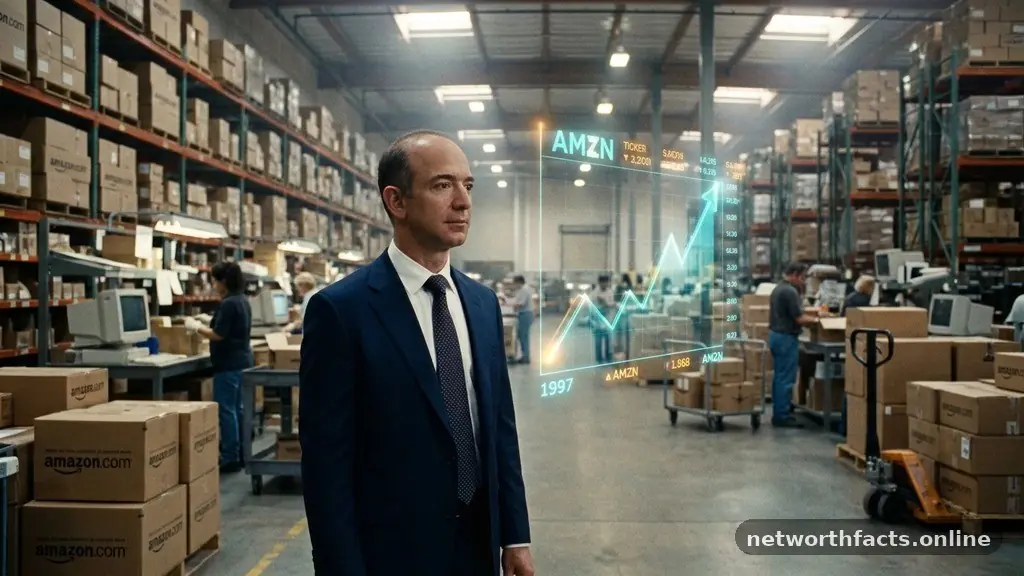
Amazon went public in May 1997, with an initial public offering priced at $18 per share before later stock splits. The IPO gave Amazon access to capital for warehouses, software, hiring, and international growth at a time when many investors still doubted that online retail could become a durable business.
Public ownership also created a powerful long-term wealth mechanism for Bezos. As Amazon’s market value rose over decades, his founder’s stake became extraordinarily valuable even though he did not receive that value as a conventional salary.
Amazon endured the dot-com crash, periods of heavy spending, criticism over working conditions, and repeated investor concerns about thin margins. Its survival depended on maintaining customer demand while building businesses such as AWS that produced different economics from retail.
Bezos stepped down as Amazon CEO in July 2021. Andy Jassy, previously head of AWS, became chief executive, while Bezos moved into the role of Amazon executive chairman and continued to focus on selected projects outside daily operations.
What Bezos’ Amazon career created
The financial impact of Bezos’ Amazon career came from ownership, not from a conventional executive paycheck. He founded the company, held shares as it expanded, and benefited when investors valued its future earnings, logistics network, subscription ecosystem, advertising business, and cloud operations.
Amazon’s growth was not a straight line. In its early years, the company often prioritised revenue growth and infrastructure over reported profits, which meant Bezos’ personal wealth could rise or fall sharply with investor confidence.
- 1994: Bezos founded the business that became Amazon after leaving D. E. Shaw.
- 1995: Amazon began selling books online.
- 1997: Amazon completed its IPO and became a public company.
- 2005: Amazon Prime launched, changing the relationship between customers and delivery.
- 2006: Amazon Web Services began offering cloud infrastructure services.
- 2013: Bezos personally bought The Washington Post for $250 million.
- 2021: Bezos ended his Amazon CEO tenure and became executive chairman.
Prime helped Amazon make delivery speed and membership convenience central to its retail model. Customers paid an annual fee, while Amazon gained a group of shoppers more likely to return frequently and buy across several categories.
AWS added another major engine. Cloud computing allowed businesses, governments, developers, and startups to rent computing power, storage, and software tools instead of building all their own data centres, creating a high-value technology platform inside a company known for retail.
Advertising became another important business. Sellers paid for visibility within Amazon’s shopping environment, giving the company a revenue stream connected to purchase intent rather than only product margins.
These activities explain why Amazon’s valuation grew far beyond that of a traditional bookseller. They also explain why Bezos’ wealth is linked to several different business models operating under one corporate umbrella.
Amazon stock ownership and the wealth engine
Amazon stock ownership remains the clearest reason Bezos ranks among the world’s wealthiest individuals. He has periodically sold shares, including sales associated with funding Blue Origin and other personal priorities, yet his remaining position has continued to represent a large financial asset.
A billionaire’s reported net worth is often misunderstood as spendable income. Bezos does not receive hundreds of billions of dollars each year; instead, the market assigns a value to his shares, and that valuation changes as investors reassess Amazon’s sales, profits, competition, regulation, and growth prospects.
Consider a simplified example. If someone owns shares worth $150 billion and the stock rises 10 percent, the paper value of that stake rises by $15 billion before taxes or sales, even though no new cash has entered the owner’s bank account.
The opposite is equally true. A weak earnings report, higher interest rates, a technology sell-off, or concerns about regulation can lower Amazon’s share price and shrink the estimated fortune without Bezos selling anything.
Why shares matter more than salary
Executive pay attracts attention, but founder equity usually matters much more in a case like Bezos’. Amazon’s long-term expansion transformed a relatively small early ownership position into an asset worth far more than decades of salary could have produced.
Bezos has used share sales as a source of liquidity, but selling stock carries trade-offs. It can generate capital-gains taxes, reduce voting influence, and create public market pressure if a transaction is large enough.
Amazon also uses stock-based compensation for employees, which can affect the total number of shares outstanding. Investors therefore examine not only the share price but also dilution, company repurchases, and the number of shares held by major investors.
Readers tracking Bezos’ fortune should focus on three facts: the current Amazon price, his reported share count, and the valuation assigned to private assets. A wealth ranking is useful as a snapshot, not as a personal financial statement.
Blue Origin and Bezos’ private investments
Blue Origin is Bezos’ most visible long-term investment outside Amazon. He founded the space company in 2000 with a focus on reusable launch systems, orbital infrastructure, lunar technology, and the broader goal of enabling people to live and work in space.
Blue Origin developed the New Shepard suborbital vehicle, which has carried research payloads and passengers, and the larger New Glenn orbital rocket. The company has worked for years on rockets, engines, launch facilities, and lunar systems, making it a capital-intensive project with a long development timeline.
Bezos has described space exploration as a project intended to preserve Earth by moving some industrial activity beyond the planet. That ambition helps explain why Blue Origin does not operate like a quick-return technology startup; major aerospace programmes require testing, regulatory approvals, manufacturing capacity, and patience.
Bezos has personally sold Amazon shares to fund Blue Origin. The amount spent is not fully disclosed in a continuously updated public ledger, but the company is widely understood to have received billions of dollars in founder backing over time.
Bezos Expeditions and other holdings
Bezos Expeditions is associated with investments in technology, healthcare, media, and other sectors. The portfolio has included early or significant investments in companies such as Airbnb, Uber, Twitter, Workday, and Basecamp, although the status and size of individual positions can change.
Private investment information is less transparent than Amazon ownership. A listed company must report major shareholder information and financial results, while a private investment vehicle does not provide the public with a complete, real-time balance sheet.
Bezos’ personal assets also include luxury real estate. Reports have described properties in Washington state, California, Texas, and Hawaii, but property values are estimates based on purchase prices, comparable sales, and local market conditions rather than a single official appraisal.
The Washington Post is another major holding. Bezos purchased the newspaper personally in 2013 for $250 million, separate from Amazon, and the organisation has invested heavily in digital subscriptions, newsroom technology, data systems, and national reporting.
These holdings broaden his financial footprint, but they do not carry the same valuation clarity as Amazon. That is why public net-worth estimates tend to be more confident about his listed shares than about Blue Origin, private investments, or media assets.
Philanthropy and major funding commitments
Bezos has directed substantial money toward philanthropy, although his approach has developed more gradually than the public giving programmes associated with some other technology billionaires. His major initiatives include the Bezos Earth Fund, the Day One Fund, and personal donations to institutions and causes.
The Bezos Earth Fund committed $10 billion to climate and nature-related grants, with the intention of distributing the money by 2030. Grants have supported conservation, climate justice, emissions reduction, food systems, and organisations working to protect ecosystems.
The Day One Fund was announced in 2018 with a $2 billion commitment. It focuses on two broad areas: helping families experiencing homelessness and creating a network of tuition-free preschools in underserved communities.
These commitments are not the same as annual personal spending. A foundation or grant-making organisation may distribute funds across multiple years, and the impact depends on how recipients use the money, how programmes are measured, and whether public institutions continue the work.
Bezos has also made individual gifts, including a widely reported $200 million donation to the Smithsonian’s National Air and Space Museum in 2021. One portion supported the museum’s renovation, while another supported educational programming.
Philanthropy affects the interpretation of Bezos’ wealth in two ways. It demonstrates that a substantial amount of capital is being directed outside his private portfolio, but it also raises questions about accountability, tax treatment, grant selection, and the role of billionaire donors in setting public priorities.
The strongest assessment should consider both the size of the pledges and the money actually distributed. A commitment announced today can shape future work, but it should not automatically be counted as a completed charitable contribution.
How Bezos’ wealth differs from income
Bezos’ wealth has primarily grown through asset appreciation. Amazon shares became more valuable as the company expanded, while private holdings and real estate added further value, meaning his financial story is closer to ownership economics than to a high annual salary.
Taxes are also more complicated than simply applying an income-tax rate to a billionaire’s net worth. Unrealised gains on shares generally are not treated the same way as wages, while selling appreciated stock can create taxable capital gains depending on the transaction and applicable laws.
Some wealthy investors borrow against assets rather than sell them. Loans secured by shares may provide liquidity without an immediate sale, but they create interest costs and the risk that falling asset prices could require additional collateral or forced selling.
Bezos has sold Amazon shares publicly over the years, and public filings can reveal certain transactions. Those filings do not necessarily show every asset, liability, trust arrangement, or private investment, so outside observers should avoid treating a published wealth estimate as a complete financial disclosure.
The risks behind the headline number
Amazon remains a huge company, but its stock can be affected by competition from Walmart, Microsoft, Google, Alibaba, cloud providers, logistics companies, and smaller digital retailers. Regulatory action, labour costs, shipping expenses, advertising trends, and consumer demand can all influence its value.
Blue Origin carries a different risk profile. Rocket development can take years, failures can be expensive, and commercial success depends on launch reliability, government contracts, customer demand, and the company’s ability to build at scale.
Private assets create valuation risk as well. A newspaper, investment portfolio, or space company may look valuable in a funding round or internal estimate but could be worth less in an actual sale.
That mixture makes Bezos’ fortune both enormous and exposed to changing assumptions. The number is real as a measure of ownership, but it is not guaranteed wealth in the same way as cash held in a deposit account.
What readers can learn from the Amazon story
Bezos’ career offers a specific lesson about scale: Amazon began with one product category, then used technology, logistics, membership, and infrastructure to move into adjacent markets. The expansion was not just about adding products; it involved building systems that made each new category easier to serve.
Another lesson is the value of reinvestment, though it should not be treated as a universal recipe. Amazon spent heavily on fulfilment centres, software, delivery networks, devices, and AWS infrastructure, and those investments only became valuable because customers adopted the resulting services.
Bezos also showed the importance of separating a company’s mission from a single quarterly result. Amazon’s long-term letters to shareholders repeatedly emphasised customer experience, experimentation, and willingness to accept short-term costs for larger opportunities.
There were trade-offs. Amazon faced criticism over warehouse conditions, marketplace counterfeit goods, tax practices, competitive behaviour, and its effect on traditional retailers, so growth alone does not settle every question about a company’s social impact.
- Study how revenue is produced rather than relying only on a company’s brand.
- Distinguish a founder’s paper wealth from spendable cash.
- Check whether a reported figure is current, estimated, and tied to a specific date.
- Separate charitable pledges from grants already distributed.
- Compare private-company valuations with the greater transparency of listed shares.
For individual investors, the most practical lesson is not to imitate Bezos’ asset choices mechanically. Amazon stock, space ventures, and private technology investments carry risks that may be unsuitable for someone without his resources, time horizon, and access to liquidity.
A better takeaway is to understand ownership, compounding, diversification, and downside exposure. Bezos built wealth by holding a concentrated stake for decades, but most households need a more balanced approach because one falling asset cannot threaten their entire financial future.
Frequently asked questions
What is Jeff Bezos’ net worth?
Jeff Bezos’ net worth is generally estimated at around $200 billion or more during strong Amazon market periods, but the number changes daily. Most of the fortune comes from Amazon shares, while Blue Origin, real estate, private investments, and The Washington Post are harder to value precisely.
How did Jeff Bezos make most of his money?
He made most of his money by founding Amazon and retaining a large ownership stake as the company grew from an online bookstore into a global e-commerce, cloud computing, advertising, subscription, and logistics business. The increase in Amazon’s share price created far more value than a normal executive salary could have produced.
Does Jeff Bezos still own Amazon?
Yes. Bezos remains one of Amazon’s largest individual shareholders, although he has sold shares over time. His exact ownership percentage can change through sales, company share activity, and other transactions, so current figures should be checked against recent regulatory filings.
What companies does Jeff Bezos invest in?
His investment interests include Blue Origin, Bezos Expeditions holdings, The Washington Post, real estate, and various technology, healthcare, media, and consumer companies. The full portfolio is not publicly disclosed in one complete, real-time list.
How much did Bezos pay for The Washington Post?
Bezos paid $250 million in 2013 to purchase The Washington Post personally. The transaction was separate from Amazon, and the newspaper has since pursued a digital strategy involving subscriptions, technology, data, and expanded national coverage.
What Jeff Bezos’ fortune really represents
Jeff Bezos Net Worth, Amazon Career, and Investments are best understood as one connected story of founder ownership, long-term reinvestment, and expanding ambitions. Amazon created the fortune, while Blue Origin, Bezos Expeditions, The Washington Post, and philanthropy show how he has chosen to deploy it.
The exact number will keep moving, but the durable facts are clearer: Bezos founded Amazon, held valuable equity, left the CEO role in 2021, and continues to direct capital toward business, space, media, and charitable projects. If you follow his wealth, always check the date, distinguish estimates from cash, and look beyond the headline figure to the assets behind it.