Elon Musk Net Worth, Companies, and Sources of Wealth
Elon Musk’s net worth, companies, and sources of wealth are closely tied to shares in Tesla, private-company equity in SpaceX, and a portfolio that also includes xAI, X, Neuralink, and The Boring Company. Unlike a fortune built mainly from salary or cash savings, Musk’s wealth rises and falls with market prices and private valuations.
That distinction explains why published wealth estimates can differ by tens of billions of dollars on the same day. The clearest way to assess the figure is to separate Musk’s early technology exits, Tesla stock ownership, SpaceX valuation, and the newer ventures that may matter more in the future than they do in current net-worth calculations.
What Is Elon Musk’s Net Worth?
There is no single official, permanent answer to the question of Elon Musk net worth. Public estimates from major financial outlets have placed it in the broad range of roughly $180 billion to more than $200 billion during periods when Tesla and privately held SpaceX were valued highly, but the number can move sharply with the stock market.
Forbes and Bloomberg use different methods, assumptions, and timing when valuing private businesses, debt, pledged shares, and compensation awards. A quote from Tesla can change the estimated value of Musk’s publicly traded holdings within minutes, while a SpaceX valuation may remain unchanged for weeks or months until a funding round or private share sale establishes a new reference point.
| Wealth component | Why it matters | How it is valued |
|---|---|---|
| Tesla ownership | Large public-company stake and equity awards | Share price multiplied by attributable shares |
| SpaceX ownership | Private equity in a major aerospace business | Recent private-market valuation, adjusted for ownership |
| X | Acquired social-media company with changing value | Estimated from purchase price, funding, and private transactions |
| xAI and other ventures | Potentially valuable private-company interests | Funding rounds and reported investor valuations |
The figure is therefore best understood as an estimate of assets minus known liabilities, not money sitting in a bank account. Musk could not convert every holding into cash instantly without affecting prices, facing taxes, or accepting discounts for private-company shares.
In practical terms, Tesla and SpaceX have usually been the two largest pillars. Tesla provides a transparent market price, while SpaceX contributes a private-company value based on investor transactions and expectations about launch services, Starlink, and future space infrastructure.
How Zip2 and PayPal Created the First Fortune
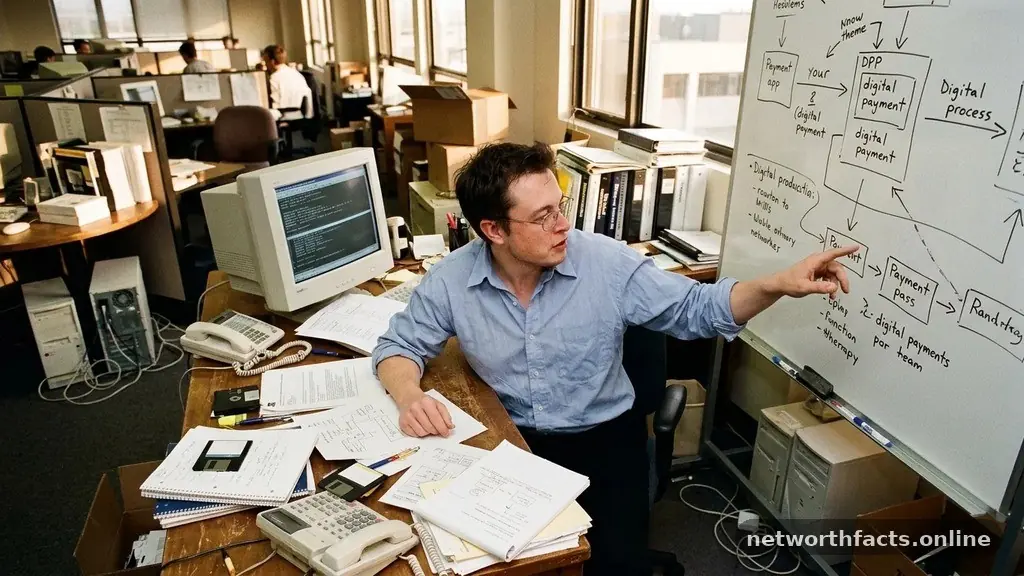
Musk’s wealth story began before Tesla and SpaceX. In 1995, he helped create Zip2, a company that supplied online city guides and business directories to newspapers, and Compaq acquired it in 1999 for approximately $307 million in cash and stock.
That sale gave Musk an early pool of capital, but it did not make him one of the world’s richest people. His next major step came through X.com, an online financial-services company he founded in 1999, which later merged with Confinity, the company behind PayPal.
eBay acquired PayPal in 2002 for $1.5 billion in stock. Musk was not the sole founder of PayPal, and his personal proceeds were far smaller than the headline deal value, yet the exit gave him enough capital to finance much larger and riskier projects.
The importance of PayPal was strategic as well as financial. Musk could use money from the sale to fund SpaceX, support Tesla during difficult periods, and pursue businesses with long development timelines that traditional lenders might have considered too uncertain.
Why the early exits still matter
Zip2 and PayPal established a pattern that shaped the rest of Musk’s career: build or back a technology company, retain meaningful equity, and reinvest the proceeds into another ambitious venture. The early exits were the foundation, not the main source of his present-day wealth.
- Zip2: Provided Musk with an early technology-company exit and startup experience.
- X.com and PayPal: Produced the capital that helped finance later ventures.
- SpaceX: Turned personal capital into a long-term private-company stake.
- Tesla: Created the public-market equity exposure that eventually dominated his wealth estimates.
This distinction matters because online discussions sometimes credit PayPal with creating Musk’s entire fortune. PayPal supplied the launch capital, but Tesla’s market value and SpaceX’s private valuation created most of the extraordinary increase that followed.
Tesla and the Power of Stock Ownership
Tesla has been the most visible driver of Musk’s net worth because it is publicly traded and therefore repriced continuously. Musk joined Tesla as an early investor and became chairman in 2004 before taking the chief executive role in 2008; the company later grew from a niche electric-car manufacturer into a major global automaker and energy business.
His financial interest has included common stock and performance-based equity awards. The exact percentage changes as he exercises options, sells shares, receives compensation, pays taxes, or uses stock as collateral, so a current ownership figure should always be checked against a recent filing rather than repeated from an old profile.
Tesla’s share price has experienced enormous gains and declines. A large percentage move in the stock can add or subtract billions of dollars from the paper value of Musk’s holdings without any new cash entering his personal bank account.
Stock-based compensation also makes the story more complicated. Musk’s 2018 Tesla compensation plan was tied to market-capitalization and operational milestones, rather than a conventional salary, and the package became the subject of extensive litigation in Delaware.
Public filings provide the clearest ownership evidence
Tesla’s proxy statements and regulatory filings identify share ownership, option awards, and related transactions more reliably than social-media posts or recycled wealth rankings. Readers who want primary documentation can consult the U.S. Securities and Exchange Commission filings for Tesla.
Those documents also show why “Musk owns Tesla” is too imprecise. He owns a substantial interest, but the company has millions of other shareholders, including institutional funds and individual investors, and his percentage can change over time.
Tesla has also connected Musk’s wealth to several business lines beyond vehicle deliveries. Battery storage, charging infrastructure, software, and autonomous-driving ambitions influence how investors value the company, although those expectations can be debated and may not translate into immediate profits.
The result is a fortune that is unusually sensitive to one public company. When Tesla’s valuation expands, Musk can rise rapidly in global wealth rankings; when investors reassess growth, competition, margins, or governance, the same exposure works in reverse.
SpaceX and Its Private-Company Valuation
SpaceX is the other central source of Musk’s wealth. He founded the rocket company in 2002 with the goal of reducing launch costs and eventually supporting human settlement beyond Earth, and the business developed the Falcon launch family, Dragon spacecraft, and the reusable Falcon 9 first stage.
Unlike Tesla, SpaceX does not trade on a stock exchange. Its value is inferred from private funding rounds, employee share transactions, tender offers, and negotiations among sophisticated investors, meaning wealth estimates must apply a valuation to Musk’s ownership rather than observe a live market price.
SpaceX’s business has two particularly important engines. Government and commercial launch contracts provide revenue through Falcon missions, while Starlink uses a large satellite network to sell broadband service to customers in areas with limited terrestrial connectivity.
Starlink has changed the way investors view SpaceX. The company is no longer valued only as a rocket manufacturer; it is also seen as a communications operator with recurring subscription revenue, expensive satellite deployment requirements, regulatory obligations, and a potentially global customer base.
Why SpaceX estimates are uncertain
A private-company valuation is not the same as cash in the owner’s possession. If a financing round values SpaceX at a particular level, that price reflects a limited transaction involving specific shares and terms, not necessarily the price available for every share Musk owns.
Ownership can also be diluted when a private company issues new shares to employees or investors. Debt, tax obligations, different classes of shares, and restrictions on selling stock may further separate a headline SpaceX valuation from the value that belongs directly to Musk.
Even with those limitations, SpaceX has become a major wealth pillar because investors have repeatedly assigned it a high valuation based on launch reliability, Starlink growth, and the possibility of future space transportation. That private-company equity is one reason Musk’s estimated fortune can remain enormous even when Tesla shares fall.
X, xAI, Neuralink, and The Boring Company
Musk’s newer companies broaden his business interests but do not all contribute equally to his current net worth. Their importance depends on ownership, outside funding, revenue, operating costs, and whether a credible private-market valuation exists.
X, formerly Twitter
Musk led the acquisition of Twitter in 2022 in a transaction reported at approximately $44 billion. He contributed equity alongside outside investors and financed part of the purchase with debt, which made X a very different asset from Tesla stock.
The company was renamed X and remained privately held. Its value has been difficult to measure because advertising revenue, user activity, subscription sales, debt costs, and platform changes have shifted since the acquisition, while there is no daily public share price.
xAI and artificial intelligence
xAI was launched in 2023 to develop artificial-intelligence systems, including the Grok chatbot. The company has been connected to Musk’s broader technology ecosystem through access to data, computing resources, and relationships with X and other businesses, although its ownership structure and valuation can change as new investors participate.
Artificial intelligence has attracted enormous private-market funding, so even a minority stake in a rapidly funded company could become meaningful. Still, reported fundraising valuations should not automatically be treated as Musk’s personal profit or as guaranteed future wealth.
Neuralink and The Boring Company
Neuralink develops brain-computer interface technology, while The Boring Company works on tunnel-based transportation infrastructure. Both are private businesses, and their valuations are less transparent than Tesla’s.
Neuralink’s technology carries long clinical, regulatory, and engineering timelines. The Boring Company’s projects depend on permits, construction economics, local contracts, and whether tunnel systems can deliver practical transportation benefits at scale.
- News and social media: X, formerly Twitter, exposes Musk to advertising, subscription, and debt-related risks.
- Artificial intelligence: xAI may gain value from demand for advanced models, but it competes in a capital-intensive field.
- Biotechnology: Neuralink’s progress depends on trials, safety, regulation, and medical adoption.
- Infrastructure: The Boring Company faces project-by-project execution and approval challenges.
Why Wealth Estimates Move So Quickly
Net-worth rankings are snapshots, not audited personal balance sheets. The most visible change comes from Tesla stock, whose market price updates continuously during trading hours and can move because of earnings, delivery figures, interest rates, competition, or a single public comment.
Private assets create a second layer of uncertainty. SpaceX, X, xAI, Neuralink, and The Boring Company don’t provide a live price for every share, so valuation services rely on recent transactions and their own judgments about comparable companies, business performance, and investor demand.
Debt matters, too. Musk has used borrowing arrangements connected to shares, and acquisition financing for X introduced liabilities associated with the company and its investors. A headline asset figure can therefore overstate economic wealth if it ignores obligations or treats all equity as immediately sellable.
| Factor | Effect on an estimate | Reason for caution |
|---|---|---|
| Tesla share price | Can change the estimate within minutes | Paper gains are not realized cash |
| SpaceX funding round | Creates a new private valuation reference | Limited transactions may not represent every share |
| Stock sales or option exercises | Change ownership and cash holdings | Taxes and market impact affect the result |
| Debt and pledged shares | Reduce net economic value or add risk | Terms may not be fully visible in a simple ranking |
Tax treatment can also alter the outcome. Selling appreciated Tesla shares may create a large tax bill, while exercising options can involve income-tax consequences even if the shares are not immediately sold.
For that reason, readers should compare several reputable estimates, record the date of each figure, and avoid presenting a rounded number as a permanent fact. “Musk is worth around $200 billion” may be a useful approximation for a given period, but it is not a stable accounting value.
How the Companies Fit Together
Musk’s companies are separate legal entities, yet they form a connected technology portfolio. Tesla focuses on electric vehicles, energy storage, and related software; SpaceX operates in the aerospace industry and satellite communications; xAI develops artificial intelligence; X provides a social-media and distribution platform.
That combination can create practical advantages. Tesla and SpaceX generate large pools of engineering knowledge, X supplies a direct communications channel to a huge audience, and xAI can draw on computing and data relationships that are difficult for a new startup to assemble from nothing.
The connections also create risks. A product, executive decision, regulatory dispute, or public controversy at one company can affect perceptions of the others because investors and customers associate them strongly with Musk personally.
Concentration is the central financial feature
Musk’s fortune is not diversified in the same way as a conventional portfolio of global index funds, bonds, real estate, and private businesses. Much of it is tied to technology and growth assets whose valuations depend on expectations about future markets.
That concentration has produced extraordinary upside. Tesla’s transformation and SpaceX’s progress created value on a scale that would have been unlikely from salary income alone, and ownership allowed Musk to benefit directly as investors reassessed each company.
It also creates unusual downside exposure. A prolonged decline in Tesla, weaker demand for Starlink, expensive AI competition, or problems at X could affect both individual company values and the broader market confidence attached to Musk’s portfolio.
This is why his story is best described as ownership-driven wealth. The key asset is not a huge annual paycheck; it is the continuing value of equity in companies that he founded, helped build, or controls.
Frequently Asked Questions
Is Elon Musk’s net worth mostly cash?
No. Most of the estimated fortune is associated with equity in Tesla, SpaceX, and other businesses rather than cash deposits. Converting those holdings into cash could trigger taxes, require private-market buyers, and affect the price of publicly traded shares.
Which company made Elon Musk the most money?
Tesla has generally been the largest contributor to the growth of his estimated wealth because he holds a significant stake in a publicly valued company. SpaceX is also extremely important, and its private valuation may rival or exceed the value of Tesla-related holdings during some periods.
Does Musk own all of SpaceX?
No. SpaceX has outside investors and employees with equity interests, so Musk is not the sole owner. His exact economic stake can change through fundraising, employee grants, and private share transactions.
How did PayPal affect Musk’s fortune?
The eBay acquisition of PayPal in 2002 gave Musk capital from an early technology exit. He used that foundation to pursue SpaceX, support Tesla, and fund other ventures, but PayPal itself is not the main source of his present-day net worth.
Why do Forbes and Bloomberg report different numbers?
They may use different share counts, private-company valuations, debt assumptions, and update schedules. Their figures can also be published at different moments, especially when Tesla’s stock price is moving rapidly.
What the Numbers Really Show
Elon Musk Net Worth, Companies, and Sources of Wealth are inseparable from one central fact: his fortune is primarily the market value of ownership stakes, not accumulated salary. PayPal supplied early capital, Tesla created vast public-market exposure, and SpaceX added a highly valued private-company asset.
Estimates will continue to shift as Tesla trades, SpaceX completes private transactions, and xAI or other ventures mature. The most useful next step is to check the date and methodology behind any published figure, then separate confirmed ownership from speculative future value.
That approach gives a more realistic picture of Elon Musk’s net worth and explains why the number can change so dramatically. It also leaves room for the story to develop as his companies compete across transportation, aerospace, communications, artificial intelligence, and biotechnology.