Mark Zuckerberg Net Worth, Career, and Business Success
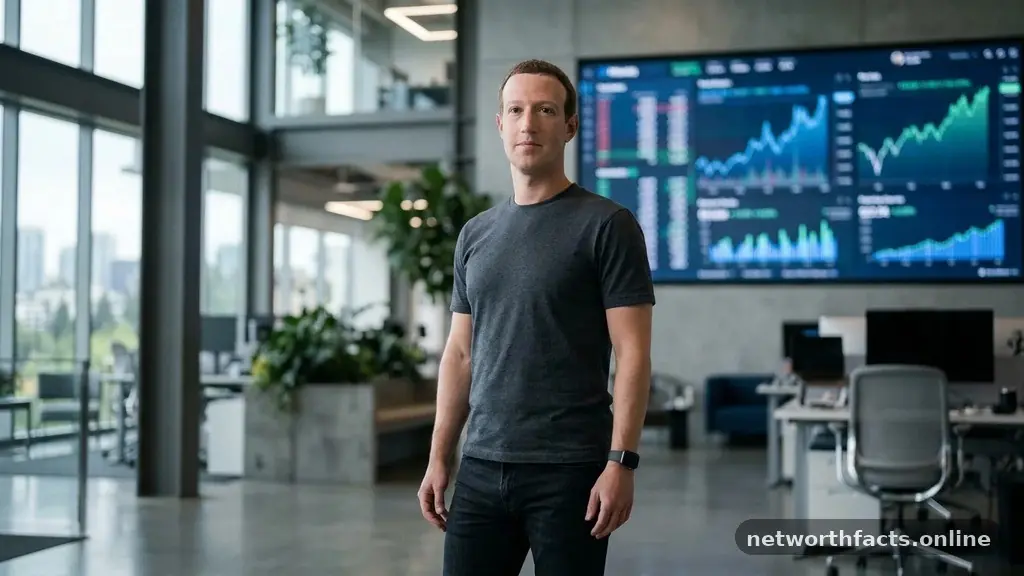
Mark Zuckerberg’s net worth, career, and business success are closely tied to one asset: his ownership of Meta Platforms, the company that grew from Facebook into a global technology group. His fortune rises and falls with Meta’s share price, while his career reflects a mix of rapid product expansion, controversial decisions, and long-term bets on digital communication.
The headline figure is an estimate, not a cash balance. By early 2025, major wealth trackers commonly placed Zuckerberg’s net worth at roughly $200 billion, although the number can change by billions in a single trading session. The most useful way to understand that wealth is to examine how Facebook began, how Meta acquired Instagram and WhatsApp, and why Zuckerberg still holds unusual voting control.
Mark Zuckerberg’s Net Worth Right Now
Mark Zuckerberg’s estimated net worth was approximately $200 billion in early 2025, based on the market value of his Meta Platforms holdings and other reported assets. The exact amount varies between publications because each outlet may use a different share price, valuation date, estimate of private investments, and treatment of charitable transfers.
That figure should not be confused with money sitting in a bank account. Most of Zuckerberg’s fortune is connected to stock ownership, particularly Meta shares, so a rise or fall in the company’s market capitalization directly affects his ranking among the world’s wealthiest people.
For a current estimate, readers can compare the latest market-based calculations on Forbes’ Mark Zuckerberg profile. Even that figure is a snapshot rather than a permanent valuation, because public shares trade continuously and billionaire rankings can change throughout the day.
| Wealth factor | What it means | Why it changes |
|---|---|---|
| Meta stock | The main source of Zuckerberg’s paper wealth | Share price, earnings, investor expectations |
| Voting control | Influence created by super-voting shares | Share ownership, company structure, stock sales |
| Cash and investments | Assets outside Meta equity | Private transactions and portfolio decisions |
| Philanthropic transfers | Money or shares committed to charitable purposes | Donations, grants, and valuation dates |
Meta’s stock performance has been especially important because Zuckerberg remains one of its largest individual shareholders. A company that generates tens of billions of dollars in annual revenue can still experience major valuation swings when investors reassess advertising demand, artificial intelligence spending, regulatory risk, or the future of the metaverse.
In practical terms, Zuckerberg’s net worth is best read as an ownership estimate. It shows the value of his economic stake at a particular moment, not the amount he could necessarily withdraw without affecting the stock price, triggering taxes, or reducing his influence over Meta.
From Harvard Student to Facebook Founder
Zuckerberg was born in 1984 and grew up in Dobbs Ferry, New York, where he developed an early interest in computers and software. Before Facebook, he created communication tools and small programs, including a music recommendation program reportedly called Synapse that attracted attention from technology companies.
He entered Harvard University in 2002 and studied psychology and computer science. Campus life supplied both the technical setting and the immediate audience for his most important project: a website that initially helped students connect through profiles and social information.
Facebook launched in February 2004 with assistance from fellow Harvard students including Eduardo Saverin, Dustin Moskovitz, Andrew McCollum, and Chris Hughes. The service first spread through Harvard, then moved to other universities before becoming available to a much broader public.
The early appeal was simple but powerful. Users could build an identity, see connections, share updates, and communicate within one growing network, while the company collected the user activity and engagement data needed to sell targeted advertising.
The early ownership dispute
Eduardo Saverin helped finance Facebook in its first phase and served as an early business partner, but his relationship with Zuckerberg later deteriorated. Legal disputes over ownership and the company’s early history were eventually settled, and the episode became part of the public narrative surrounding Facebook’s formation.
The story also shows why equity matters in a start-up. A founder’s technical contribution, an investor’s capital, and a partner’s early business work can all become difficult to value once a private project turns into a multibillion-dollar company.
Zuckerberg left Harvard before graduating to focus on Facebook. That decision carried enormous personal risk at the time, but Facebook’s rapid user growth and funding from investors gave the young company enough momentum to continue building beyond the college market.
How Facebook Became a Global Business
Facebook’s business model developed around advertising rather than subscription fees. The platform offered free access to users, then sold advertisers the ability to reach audiences based on interests, demographics, browsing behavior, and interaction with content.
That model became more valuable as the network expanded. More users created more activity, more activity produced more data and engagement, and the larger audience made Facebook more attractive to businesses seeking measurable online advertising.
Facebook also benefited from the shift from desktop computers to smartphones. Mobile applications kept users connected throughout the day and allowed Meta to serve advertising across news feeds, messages, video, and other digital surfaces.
- Network effects: the platform became more useful as more friends, relatives, creators, and businesses joined.
- Targeted advertising: advertisers could reach defined audiences instead of buying broad, difficult-to-measure exposure.
- Global distribution: Facebook expanded far beyond the United States and became available in many languages.
- Product integration: Facebook connected social feeds, messaging, video, business pages, and advertising tools.
- Data-driven optimization: the company tested features and advertisements at enormous scale.
The company’s initial public offering, or IPO, took place in May 2012. Facebook priced its shares at $38 each, raised roughly $16 billion, and became one of the most closely watched technology listings in history.
The IPO did not make Zuckerberg wealthy overnight; his private-company ownership had already made him a billionaire. It did, however, turn a large part of that private stake into publicly traded wealth and gave investors a direct way to value the company.
Facebook’s early public-market period was not completely smooth. Concerns about mobile advertising and the company’s ability to shift user activity from computers to phones pressured the stock, but Facebook later demonstrated that mobile engagement could support a very large advertising business.
Instagram and WhatsApp Changed the Growth Story
Two of Meta’s most important decisions were its acquisitions of Instagram and WhatsApp. Both deals attracted criticism because they involved large sums and raised questions about whether Facebook was buying future competitors, yet both services became central to the company’s long-term reach.
Facebook announced the Instagram acquisition in 2012 for approximately $1 billion in cash and stock. At the time, Instagram was a small but rapidly growing photo-sharing service with a strong mobile identity and a simple creative interface.
Instagram eventually became a major advertising platform in its own right. Its visual format, creator ecosystem, Stories feature, shopping tools, and short-form video products helped Meta reach audiences who did not necessarily use Facebook in the same way.
Facebook announced the WhatsApp acquisition in 2014. The transaction was valued at about $19 billion, including cash, stock, and restricted stock units, making it one of the largest technology acquisitions of that period.
WhatsApp gave Meta a powerful position in private messaging, especially in markets where mobile communication was central and traditional SMS was less attractive. Its enormous international user base expanded Meta’s footprint beyond public feeds and advertising-led social networking.
| Acquisition | Announcement year | Reported headline value | Strategic importance |
|---|---|---|---|
| 2012 | About $1 billion | Mobile photos, creators, visual advertising | |
| 2014 | About $19 billion | Global private messaging and mobile reach |
These purchases also explain why Zuckerberg’s career cannot be judged only by Facebook’s original product. He helped transform the company from a single social network into a portfolio that included Facebook, Instagram, WhatsApp, Messenger, and other services.
Both acquisitions faced regulatory scrutiny, especially as competition authorities examined whether Meta could use ownership of major communication platforms to limit rivals. The deals became financial successes in terms of audience growth, but they also increased the political and legal attention surrounding Zuckerberg’s company.
Why Zuckerberg Renamed Facebook Meta
In October 2021, Facebook changed its corporate name to Meta Platforms. The rebrand separated the parent company from the Facebook app and signaled Zuckerberg’s interest in virtual and augmented reality, digital avatars, immersive workspaces, and the broader concept of the metaverse.
The decision came through Reality Labs, Meta’s division responsible for virtual-reality hardware and related technologies. Products such as Quest headsets gave the company a consumer device business, but Reality Labs also recorded substantial operating losses as Meta funded research, hardware development, software, and infrastructure.
Zuckerberg’s metaverse strategy required patience because the commercial audience for immersive computing was much smaller than the audience for social media. The company spent heavily while investors questioned whether virtual reality could produce returns large enough to justify the investment.
Meta later increased its emphasis on artificial intelligence, recommendation systems, messaging, and short-form video. Its AI investments affected both the content users see and the tools offered to advertisers, while also requiring costly data centers and specialized computer chips.
The “Year of Efficiency”
In 2023, Zuckerberg described the period as Meta’s “Year of Efficiency.” The company reduced its workforce through large rounds of layoffs, simplified parts of its organization, and focused more closely on financial discipline after years of aggressive hiring and heavy spending.
Investors responded positively as Meta’s advertising business improved and operating costs came under closer control. The resulting rise in Meta’s share price had a direct effect on Zuckerberg’s estimated fortune because his wealth remained heavily concentrated in the company.
The shift did not mean that Meta abandoned the metaverse. Instead, the company pursued artificial intelligence and social-media improvements while continuing to invest in Reality Labs, creating a portfolio with both near-term advertising revenue and longer-term technology ambitions.
Stock Ownership and Voting Control
Zuckerberg’s economic wealth and his control over Meta are related but not identical. Meta has a dual-class share structure in which certain shares carry more voting power, allowing Zuckerberg to retain significant influence even though he does not own every share of the company.
This structure is common among technology companies founded by entrepreneurs who want to protect long-term strategies from short-term shareholder pressure. In Zuckerberg’s case, it has allowed him to make major decisions about acquisitions, product direction, corporate naming, and expensive research programs.
Voting control can be valuable, but it also creates accountability questions. Public shareholders may own part of Meta’s economic value while having less ability to change leadership or redirect the company’s strategy.
His stock ownership has also changed over time through sales, charitable commitments, tax planning, and compensation-related transactions. Public reports may show share sales, but they do not always provide a complete picture of the founder’s broader personal balance sheet.
The relationship between control and wealth can be summarized in three ways:
- Economic ownership determines how much Zuckerberg benefits when Meta’s share price rises.
- Voting ownership determines how much influence he can exercise over major corporate decisions.
- Share sales can provide liquidity while reducing his exposure and, depending on the shares sold, potentially affecting voting power.
This arrangement helps explain why Zuckerberg can remain the central decision-maker at Meta despite the company’s enormous public shareholder base. It also explains why market commentators pay close attention to both his percentage ownership and the voting rights attached to his shares.
Leadership, Controversy, and Business Risk
Zuckerberg’s career has produced extraordinary growth, but it has also generated serious criticism. Facebook and Meta have faced scrutiny over privacy, election misinformation, content moderation, antitrust concerns, youth safety, political influence, and the handling of user data.
The Cambridge Analytica scandal in 2018 intensified public concern about how Facebook data could be accessed and used for political purposes. Zuckerberg testified before the United States Congress, and the company later agreed to a $5 billion settlement with the Federal Trade Commission related to privacy practices.
Regulatory pressure has remained a business risk rather than a one-time event. Governments and competition authorities have examined Meta’s acquisitions, advertising practices, platform policies, and the relationship between its services and potential competitors.
Content moderation creates another difficult operating problem. Meta must apply rules to billions of posts, comments, images, and videos across languages and cultures, yet any policy decision can provoke criticism from users, advertisers, governments, or civil-liberties groups.
There is also a financial dimension. Advertisers can reduce spending when brand-safety concerns rise, while privacy changes on mobile operating systems can make it harder for Meta to measure campaigns and target audiences as precisely as before.
Zuckerberg’s response has generally involved combining public explanations with large-scale product and infrastructure changes. Meta has invested in privacy controls, artificial intelligence moderation, security teams, election policies, and new advertising technology, though critics continue to debate whether those measures are sufficient.
For investors, the lesson is clear: Meta’s size creates powerful economies of scale, but it also makes the company a target for regulators and a highly visible participant in social and political debates.
Philanthropy and the Chan Zuckerberg Initiative
Zuckerberg and his wife, Priscilla Chan, announced the Chan Zuckerberg Initiative in 2015. The organization focuses on areas including science, education, community support, and justice, and it has committed billions of dollars to research and charitable work.
The initiative was established as a limited liability company rather than a traditional private foundation. That structure can support grants and investments, while also allowing the organization to pursue activities that may not fit neatly within conventional charitable grant-making.
One major focus has been biomedical research. The initiative has supported tools, scientific collaboration, and efforts intended to improve understanding of disease, with the broad ambition of helping prevent, manage, or cure serious illnesses.
Education has also been a significant area of activity. Programs have supported personalized learning, teacher resources, school partnerships, and community-led efforts, although education reform is complex and outcomes can vary sharply between districts and programs.
Philanthropy affects the interpretation of Zuckerberg’s net worth because charitable commitments may involve future transfers rather than immediate reductions in reported wealth. A pledge, a donated share, and a grant distributed by an organization are not the same thing for valuation or accounting purposes.
His giving has attracted both praise and criticism. Supporters point to the scale of the funding and the initiative’s willingness to back scientific infrastructure, while critics question the influence that wealthy donors can exercise over public priorities.
That debate is part of Zuckerberg’s broader public identity. He is not only a social media entrepreneur whose fortune came from Meta; he is also a major donor whose choices can shape research, education, and civic programs beyond the company’s commercial operations.
What His Career Teaches Entrepreneurs
Zuckerberg’s career offers useful lessons, but they are specific to the conditions that helped Facebook grow. The company benefited from a concentrated university network, rapid internet adoption, venture funding, and a business model that became more valuable as users invited others.
One practical lesson is to build for repeated use rather than one-time attention. Facebook’s core features encouraged people to return frequently because their friends, messages, photos, and updates changed constantly.
A second lesson is that product expansion can protect a company from dependence on one format. Meta moved from Facebook’s original social feed into mobile apps, messaging, video, creator tools, advertising software, virtual reality, and artificial intelligence.
Acquisitions also played a central role. Instagram and WhatsApp were not merely purchased assets; they were platforms with distinct communities, product cultures, and growth patterns that Meta eventually connected to its broader advertising and infrastructure systems.
There are cautionary lessons, too. Founder control can speed up decision-making, but it can also make a company’s direction dependent on one person’s judgment. Heavy spending on a future technology can create pressure when investors want immediate returns.
Entrepreneurs studying Zuckerberg’s path should focus on mechanisms rather than celebrity. The important questions are how the company acquired users, created revenue, defended its market position, managed platform risk, and converted equity ownership into durable strategic control.
Frequently Asked Questions
How much is Mark Zuckerberg worth?
Mark Zuckerberg’s net worth was widely estimated at roughly $200 billion in early 2025. The figure changes with Meta’s share price, his reported holdings, charitable transfers, and the methods used by different wealth-ranking publications.
What made Mark Zuckerberg so wealthy?
His wealth primarily comes from stock ownership in Meta Platforms, the parent company of Facebook, Instagram, WhatsApp, Messenger, and Reality Labs. Meta’s advertising revenue and rising market value have increased the paper value of his stake over time.
Does Mark Zuckerberg still control Meta?
Yes, he retains substantial voting control through Meta’s dual-class share structure. His voting power gives him influence over major corporate decisions even though public investors own significant portions of the company.
What were Meta’s biggest acquisitions?
Two of the most important were Instagram, acquired for about $1 billion in 2012, and WhatsApp, acquired in a transaction valued at approximately $19 billion in 2014. Both services expanded Meta’s reach well beyond the original Facebook platform.
How does Zuckerberg give away money?
Much of his large-scale philanthropy is associated with the Chan Zuckerberg Initiative, which supports science, education, justice, and community programs. Contributions may take the form of grants, investments, or transfers of assets rather than simple cash donations.
What Zuckerberg’s Success Really Shows
Mark Zuckerberg’s Net Worth, Career, and Business Success are inseparable from Meta’s extraordinary scale. His estimated fortune of about $200 billion is mainly an ownership calculation, while his lasting business achievement is the creation of a global platform family that includes Facebook, Instagram, and WhatsApp.
The next useful step for readers is to separate headline wealth from the underlying facts: share price, stock ownership, voting control, acquisitions, advertising revenue, and philanthropic commitments. That distinction makes the story more accurate—and more interesting—than any single billionaire ranking.