Dwayne Johnson Net Worth, Movies, and Business Ventures
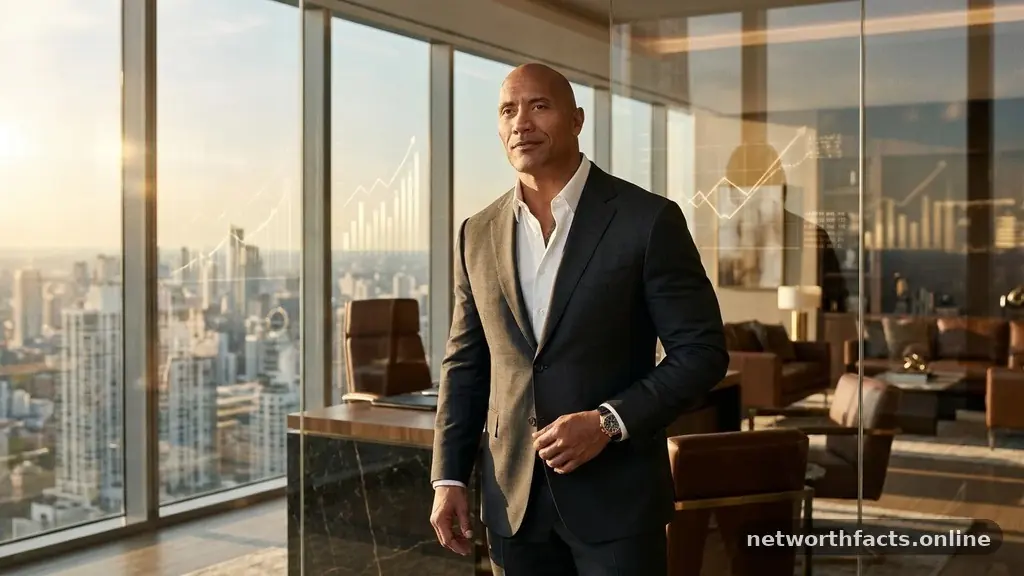
Dwayne Johnson’s net worth, movies, and business ventures tell a bigger story than a celebrity salary. The Rock moved from WWE fame into blockbuster films, producer credits, consumer brands, and ownership stakes that can keep generating value beyond a single paycheque.
Public estimates place his fortune near $800 million, although no audited personal balance sheet confirms that figure. His path from professional wrestling to Hollywood and entrepreneurship offers useful context for understanding how that wealth was built, where the biggest estimates come from, and why the number can change as private companies grow or lose value.
Dwayne Johnson’s estimated net worth
Public estimates generally put Dwayne Johnson’s net worth at approximately $800 million in the mid-2020s. That figure should be treated as an informed estimate rather than an official disclosure, because Johnson does not publish a complete list of his assets, debts, contracts, tax obligations, or private-company valuations.
The estimate is also different from the amount Johnson has earned in a single year. Forbes has repeatedly placed him among the world’s highest-paid actors in strong earning years, with income coming from film fees, producer compensation, endorsements, and business activity. A large annual income may increase wealth, but taxes, agents, production costs, investments, and spending all affect the final net worth.
Johnson’s financial position is unusually broad for an entertainer. His earnings have included acting pay from films such as Jumanji, Red Notice, Black Adam, and entries connected to the Fast & Furious universe, while his companies have created additional equity and licensing opportunities.
| Wealth area | What is publicly established | Why the value is difficult to calculate |
|---|---|---|
| Film and television | Large acting fees and producer compensation | Contracts, bonuses, and backend terms are often private |
| Seven Bucks Productions | Production company founded by Johnson and Dany Garcia | Private-company ownership and profits are not fully disclosed |
| Teremana Tequila | Fast-growing tequila brand with major distribution | Brand value is not the same as Johnson’s personal cash |
| Project Rock | Performance-lifestyle partnership with Under Armour | Payments may involve royalties, licensing, and contract terms |
| Other holdings | Consumer products, endorsements, property, and investments | Private assets and liabilities are rarely itemised publicly |
For readers comparing celebrity estimates, the most responsible conclusion is that Johnson is almost certainly worth hundreds of millions of dollars, while the exact figure remains uncertain. The frequently cited $800 million figure is useful as a scale indicator, not as a verified bank balance.
How WWE made The Rock a global name
Johnson’s first major public platform was WWE, where he initially performed as Rocky Maivia before becoming The Rock. The change mattered because his confident promos, sharp timing, and ability to connect with live audiences transformed a mixed early reception into one of professional wrestling’s defining character arcs.
His WWE career included major rivalries with Stone Cold Steve Austin, Triple H, The Undertaker, and John Cena. The Rock’s catchphrases and crowd control made him valuable not only as a wrestler but also as a reliable television personality who could carry long promotional segments and headline large events.
WWE created a strong commercial foundation before Hollywood became his main arena. It gave Johnson name recognition, performance training, international exposure, and a fan base that followed him into film, advertising, social media, and product launches.
He also maintained a meaningful relationship with the company after becoming a full-time actor. Johnson appeared at selected WWE events, returned for major storylines, and was named a member of TKO Group Holdings’ board in 2024 after TKO was formed through the merger of WWE and UFC operations.
That corporate role is distinct from his wrestling income, but it shows how his connection to WWE developed beyond nostalgia. The company helped launch his public identity, while his later business career positioned him as a partner and decision-maker rather than simply a former performer.
- 1996: Johnson made his WWE debut as Rocky Maivia.
- Late 1990s: The Rock persona became one of wrestling’s central attractions.
- 2000s: His film career expanded while WWE appearances became less frequent.
- 2010s: Johnson returned for major WWE moments alongside his Hollywood work.
- 2024: He joined the TKO Group Holdings board and became more formally connected to WWE’s corporate future.
Johnson’s wrestling background still shapes his business style. He sells products with the same direct energy he once brought to a wrestling arena, but the commercial engine now includes manufacturing, distribution, media rights, and equity ownership.
Movie earnings and the Hollywood engine
Johnson’s transition to film accelerated after early appearances in projects such as The Mummy Returns and The Scorpion King. As his profile increased, he became a dependable lead for action, comedy, family entertainment, and franchise films, which gave studios several ways to use his appeal.
The Scorpion King established him as a leading man, while films such as Walking Tall, Gridiron Gang, and Race to Witch Mountain broadened his range. His commercial momentum grew sharply with Fast Five, where his role as Luke Hobbs helped turn a supporting character into a major franchise presence.
The Fast & Furious films brought Johnson into a worldwide action brand, but Jumanji: Welcome to the Jungle showed a different kind of strength. Released in 2017, the adventure comedy became a major global hit and proved that Johnson could anchor a four-quadrant film aimed at families, teenagers, and adults.
He later led or co-led films including Rampage, Skyscraper, Jungle Cruise, Red Notice, and Black Adam. Netflix’s Red Notice demonstrated the value of his streaming appeal, while Black Adam connected him to DC’s superhero business and was produced through his company’s wider entertainment activities.
Film compensation is rarely just a simple headline salary. A contract may combine an upfront fee, box-office bonuses, executive-producer pay, promotional obligations, and incentives tied to a project’s success, so reported numbers can vary considerably between publications.
Johnson’s movie wealth also comes from consistency. A single successful film can be valuable, but a run of recognizable releases lets an actor command stronger terms, secure producer credits, and bring audiences to projects that might not otherwise have the same opening reach.
Seven Bucks Productions and creative ownership
Johnson and his former wife and business partner, Dany Garcia, co-founded Seven Bucks Productions in 2012. The name references the small amount of money Johnson has said he had after being cut from the Canadian Football League, turning a difficult personal memory into a company identity.
Seven Bucks Productions has participated in film, television, and branded entertainment projects connected to Johnson’s public profile. The company’s work has included projects associated with Ballers, Jumanji, Baywatch, Red Notice, and Black Adam, although the exact financial contribution of each production is not publicly itemised.
Producer status can change an entertainer’s economics. Instead of receiving only a performance fee, a producer may help shape the project, influence casting and marketing, and participate in a broader compensation arrangement negotiated with a studio or streaming service.
That does not mean every production automatically produces a large personal profit. Films carry significant costs, and production companies may have overhead, development expenses, financing obligations, and distribution agreements. The important point is that Seven Bucks gives Johnson a corporate vehicle for developing and packaging entertainment rather than waiting for studios to offer him roles.
The company’s partnership with Johnson’s personal brand also creates a feedback loop. A film can increase awareness of a product, a product can keep the audience engaged between releases, and the combined reach can make the next entertainment project more attractive to commercial partners.
Company ownership is one reason a celebrity net-worth estimate can rise faster than salary totals suggest. If a private business becomes more valuable, an owner’s equity may be worth more on paper even if no sale has occurred and no cash has been distributed.
Teremana Tequila and beverage brands
Teremana Tequila became one of Johnson’s most visible business ventures after its launch in 2020. The brand was positioned around small-batch tequila, accessible presentation, and a founder story built heavily around Johnson’s relationship with family, hospitality, and celebration.
Unlike a standard endorsement, a spirits brand can offer ownership or participation in the company’s long-term economics. Revenue may come from bottles sold through distributors and retailers, while value can also come from brand recognition, repeat purchases, international expansion, and the strength of the distribution network.
Teremana’s reported sales milestones have attracted attention, but brand sales should not be confused with Johnson’s personal earnings. Retail revenue is divided among producers, distributors, retailers, taxes, operating expenses, marketing, and other stakeholders before it becomes profit or increases an owner’s equity value.
The company’s appeal also rests on how consistently Johnson presents it. He frequently ties the brand to gatherings and personal rituals rather than treating it as a logo placed on a bottle. That storytelling can matter in a crowded tequila market, where consumers have many celebrity-backed and independently owned choices.
Johnson’s wider beverage activity includes ZOA Energy, an energy drink brand he launched with business partners including John Shulman and Dave Rienzi. ZOA extended his reach from entertainment into a fast-moving consumer category where product placement, retail availability, and repeat buying are central to growth.
He has also been associated with Voss Water, including a reported ownership position before the company’s majority stake was acquired by a larger investment group. Public descriptions of such transactions do not always reveal each individual’s exact proceeds, so it would be unsafe to add an unverified Voss payment to his net worth.
These ventures illustrate a practical difference between endorsement income and ownership. A paid campaign may deliver a known fee, while an ownership interest can become significantly more valuable, or less valuable, depending on sales, competition, costs, financing, and eventual transactions.
Project Rock and the partnership model
Project Rock is Johnson’s performance and lifestyle brand created with Under Armour. It began with training shoes and apparel and expanded into products such as gym equipment, bags, headphones, and other items aimed at people who identify with Johnson’s disciplined public image.
The Under Armour relationship shows how a celebrity can contribute more than a face in an advertisement. Johnson has helped promote product launches, appear in campaign content, and connect the collection to his training routines, while Under Armour supplies design, manufacturing, retail, and distribution capabilities.
The financial structure of Project Rock is not fully public. Johnson could receive a mixture of licensing income, royalties, fixed compensation, and other contractual payments, but outsiders cannot responsibly calculate his exact annual return without the underlying agreement.
Brand fit has been central to the line’s positioning. Johnson regularly shares early-morning workouts, weight training, and motivational messages, so performance apparel and gym accessories connect naturally with content his audience already follows.
The partnership also gives Johnson exposure to a different purchase cycle than movie tickets or streaming views. A film is consumed once or repeatedly at no extra charge to the viewer, while a successful shoe or training shirt can become a physical product with repeat launches, seasonal collections, and retail shelf presence.
Project Rock’s commercial value should still be judged carefully. A famous collaborator can create awareness, but inventory, sizing, manufacturing quality, return rates, retailer margins, and consumer demand determine whether attention turns into sustainable profit.
Johnson’s brand portfolio works best when each venture has a clear role. Teremana occupies spirits, ZOA targets energy drinks, and Project Rock sits in fitness apparel and equipment, allowing the same audience to encounter different products without every company selling the identical thing.
Property, endorsements, and other income
Acting and company ownership are the most visible parts of Johnson’s financial story, but endorsements can add substantial income during high-profile years. His scale on social media, film marketing value, and recognizable personal style make him attractive to brands that want a personality rather than a conventional commercial spokesperson.
Endorsement compensation depends on factors such as campaign length, territory, exclusivity, usage rights, personal appearances, and whether the celebrity owns part of the product. A one-off advertisement and a multiyear global partnership can look similar from the outside while producing very different financial outcomes.
Johnson has also earned from television appearances and hosting work. His role on shows such as The Titan Games and his hosting of major events added another category of compensation, even though television fees are usually less visible than a blockbuster film’s reported budget.
Real estate can contribute to a celebrity’s net worth, but property estimates require caution. Johnson has owned high-value homes, including property in Georgia, yet a home’s market value is not pure profit because mortgages, maintenance, taxes, insurance, transaction costs, and renovations affect the owner’s equity.
His personal brand itself is an economic asset, but it is not a line item that can be valued with precision. A post promoting a product, a surprise appearance at a business event, or a social-media announcement can influence attention, but the resulting sales cannot always be separated from advertising, distribution, and ordinary consumer demand.
Johnson’s business relationships also involve partners and co-investors. Dany Garcia has been an important collaborator across several ventures, and the presence of multiple owners means that the value of a company cannot simply be assigned to Johnson in full.
A realistic net-worth calculation therefore needs to distinguish between gross earnings, business revenue, company valuation, personal equity, and liquid cash. Treating all five as interchangeable is the fastest way to produce an impressive-looking figure that does not reflect reality.
What the number really tells us
The widely cited Dwayne Johnson net worth estimate is best understood as the result of several reinforcing careers rather than one extraordinary movie cheque. WWE supplied the first large platform, Hollywood turned recognition into high-value roles, and private companies gave Johnson a way to participate in products and productions beyond his work as a performer.
Timing has mattered. Johnson entered film when studios were increasingly interested in recognizable global brands, then expanded into streaming, consumer goods, and social-media marketing as those channels became more important to entertainment and retail.
His companies also reduce dependence on a single income source. If a movie is delayed, a beverage brand may still sell products; if a brand campaign ends, a production credit or licensing agreement may continue generating income. Diversification does not eliminate business risk, but it can prevent one weak project from defining the entire financial picture.
There are limits to the success story. Black Adam received mixed commercial and critical results relative to the expectations surrounding it, and not every film or product launch can deliver the same return. Celebrity businesses face ordinary problems, including competition, changing consumer tastes, distribution disputes, production costs, and reputational risk.
Readers who want to verify career milestones can compare public company announcements, financial reporting, and the official WWE profile for The Rock. No single page, however, can reveal the complete private balance sheet behind an estimated fortune.
The clearest lesson is structural. Johnson’s wealth appears to come from combining performance income with ownership, production control, licensing, and long-term brand relationships, then using each audience-building success to support the next opportunity.
Frequently asked questions
How much is Dwayne Johnson worth?
Public estimates commonly place Dwayne Johnson’s net worth near $800 million in the mid-2020s. The figure is not officially audited or confirmed by Johnson, so it should be treated as an estimate that may change as private-company values, film income, property holdings, and liabilities change.
What was Dwayne Johnson’s highest-paying movie?
There is no universally verified public ranking of his highest-paying movie because actor contracts can include upfront fees, bonuses, backend participation, and producer compensation. Reports have identified very large payments for some major projects, but the final amount for each film is often private and may depend on performance targets.
Does Dwayne Johnson own Teremana Tequila?
Johnson is a founder and major public face of Teremana Tequila, but the brand involves business partners and other ownership interests. His exact percentage and the precise value of his stake have not been fully disclosed, so it would be inaccurate to treat the entire brand valuation as his personal wealth.
What businesses does The Rock own or co-own?
His business interests have included Seven Bucks Productions, Teremana Tequila, ZOA Energy, and Project Rock, the Under Armour-linked performance brand. He has also held or participated in other partnerships and investments, but the public record does not provide a complete, current list of every asset or ownership percentage.
Is Dwayne Johnson still involved with WWE?
Johnson is no longer a full-time professional wrestler, but he has continued to appear in major WWE storylines and maintain a formal connection with the company. In 2024, he joined the board of TKO Group Holdings, the parent company created after WWE and UFC were brought under the same publicly traded corporate structure.
The lasting business picture
Dwayne Johnson Net Worth, Movies, and Business Ventures are closely connected: WWE built the audience, films expanded the audience, and companies such as Seven Bucks Productions, Teremana, ZOA, and Project Rock turned that reach into ownership opportunities. The best estimate is roughly $800 million, but the exact total remains private and changeable.
For a clearer view, separate reported earnings from company revenue and distinguish brand value from personal equity. Johnson’s career is still developing, so future films, partnerships, acquisitions, and product performance may reshape the number; readers can follow verified announcements rather than treating any celebrity estimate as a fixed fact.